

This Issue

Winter 2010 - Cover Story
Not your parents’ French class

Advanced French Teacher Catherine Pettit knows her ning.
French teacher Catherine Pettit is not one to settle for complacency. Teaching at ‘Iolani for 11 years, she constantly improves her techniques and seeks better tools.Her newest teaching toy allows classes to be collaborative, creative and flexible. It’s described by a four-lettered word: ning.
“Through the use of the ning, I’ve discovered that students like to express themselves. The platform is interactive and takes lessons one step further.”
A ning is a 21st century social networking tool. Each of her five French classes has a ning site which is similar to a Facebook page but navigated and organized differently. Students intuitively use the ning after Pettit invites them to join and log on.
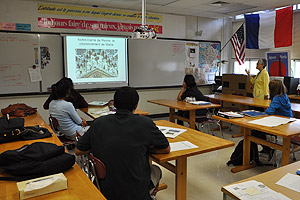
Students following the lesson in a Google Doc projected from their teacher’s desk top computer to a screen.
Other benefits of the ning include simultaneous and immediate communication. When Pettit makes an announcement to the class, she doesn’t wait until they are all assembled in their seats. She posts the message on her ning and through an RSS feed, the announcement is e-mailed to students’ gmail addresses.
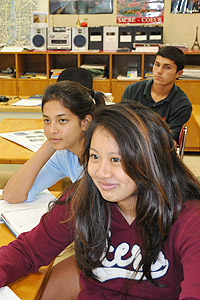
Jelene Wong ‘11, Mal'ie Yoon ’10 and Shudhi Datta ’11 are engaged by the lesson.
Students also comment on French music, movies and current events. They add to each others’ posts so that they learn from one another. They connect to Le Monde, the largest daily French newspaper, and other cultural and current event venues through websites posted on the ning. They keep news stories, photos, and other findings "en français" in one convenient digital place.
“I’m still the teacher because I initiate the lesson, but we’re learning together and we’re working with the technology,” Pettit says. “The classroom becomes extended beyond these walls, and that’s what is so wonderful.”
Students do oral presentations into their cell phones and Pettit replays them in class. Beginning and intermediate French teacher Erin Cleveland accesses nings for her seventh to ninth grade students. Other language teachers incorporate technology into their curriculums as well.
In Pettit’s Advanced Placement French class, students read articles from French newspapers or magazines. In the past, they would cut and paste the articles and submit them in class. Pettit then photocopied all of the articles for each student.
The next phase of technology allowed students to e-mail Pettit the articles which she then forwarded to the rest of the class.
Today, the digital logistics of the project are much simpler, allowing more time to delve into the articles’ content and less time worrying about how to share the information. Pettit creates a Google doc, and each student is responsible for posting his or her article into the doc for all to see.
“We are learning together what works,” she says. “The technology allows us to go beyond this classroom and learn in the real world.”