

This Issue

Winter 2010 - Cover Story
A Techie Before His Time

Physics teacher Dr. Carey “Doc” Inouye ’66 works with Gregory Lum ’10 during class.
Physics teacher Carey “Doc” Inouye ’66 was one of the first to feel the power at ‘Iolani, the power of the Internet that is.In 1997, he partnered with technology company DataHouse to create a website for his class.
“It would save me a lot of time and I could make the kids work harder,” he explains.
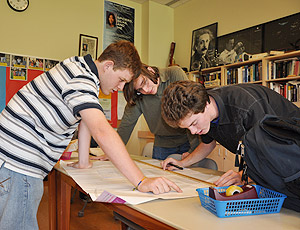
Dominic Reiss ’10, Stephen MacMillan ’10 and Taylor Van Etten ’10 measure results.
Inouye’s class website ballooned. He posted homework solutions online so that he didn’t have to waste precious class time discussing solutions unless students wanted to.
“They loved it,” Inouye says of his first Internet-engaged classes. “They had information that they needed anytime. Prior to that, I had a big binder with homework solutions, so to access that they had to come see me and it had to be during the school day.”
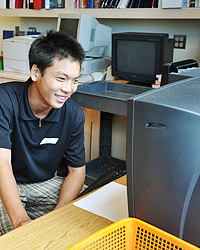
Christopher Kodama ’10 reads results from a computer terminal.
“The first time we used it, we were like, ‘Whoa!’” said physics student Lauren Makashima ’10. “But now we’re used to it. I guess we’re spoiled.”
Thanks to technology and the latest software applications, experiments that lasted weeks for students a generation ago now consume mere minutes today. Probes connected to lap tops and desk tops collect data.
When Inouye was a student, he recalls using rubber bands, toy cars and churning wheels to prove how Force = Mass x Acceleration, then recording all of the data with pencil and paper. Now, sensors plug into computers which analyze information and spit out results.
“It’s very different from the experiment I did as a student, but it’s still about questions that they have to ask and answers that they have to get before they proceed with the experiment,” Inouye adds.
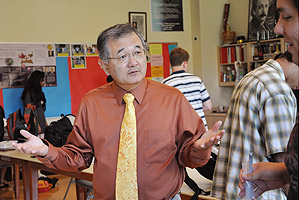
Doc Inouye encourages a student to think deeply.
In his 33 years of teaching, Inouye has practiced 21st century teaching philosophies long before they became buzz words in the new millennium. He places students in unfamiliar situations so they must search the recesses of their minds for enhancers or solutions.
“I think that by encouraging that, you try to encourage creativity, innovation,” he details. It’s no longer just what’s the answer, but how do you go about getting the answers.”