

This Issue

Once upon a time ‘Iolani teachers were not teachers just yet. They were children and teenagers like the ones they now instruct. Find out which childhood books inspired our teachers.
Read the full story »
Winter 2009 - Cover Story
Jo Ann Akamine
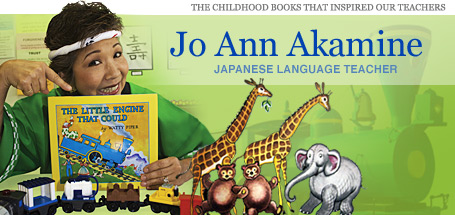
- Born:
Honolulu- Grew up:
Honolulu (Palolo)- Years teaching:
35- Yeas teaching at ‘Iolani:
32- Favorite childhood book:
The Little Engine That Could
by Watty Piper
When students get discouraged over the challenge of learning how to read, write, and speak Japanese, Jo Ann Akamine, otherwise known as Akamine Sensei, calls upon her favorite childhood book.
“When they tell me in Japanese, ‘Sensei I can’t do it,’ I say ‘Remember The Little Engine That Could?’ And some of them do know the story. And some of them will say, ‘I think I can. I think I can,’ And I say, ‘Yes! That’s right,’” reveals Akamine with an energetic expression.
Upon entering her second floor classroom with kanji on the bulletin board and an artificial plum blossom tree near the window, her advanced level pupils are expected to speak only Japanese. Leave the English at the door.
Should a boy or girl lament that they just cannot learn what they perceive to be daunting, Akamine wrinkles her brow in the sweetest way. She tells them that if they say they can’t, they won’t. If they set themselves up to fail, they will. Instead, they need to set themselves up to succeed.
“Even though you may be smaller, or not as strong or as powerful or whatever, if you put your mind to it, you can do it,” she insists.
Akamine was 5-years-old and enrolled in kindergarten at Palolo Elementary School when she first listened to the phonograph record of the book The Little Engine That Could. The booming voice of the big engine spooked her, however, leaving this impressionable child horrified.
In the tale, a long train must be pulled over a high mountain. After larger, stronger engines refuse to help for different reasons, a small engine agrees to try and succeeds.
Years later, this story’s moralistic and optimistic message comes to mind whenever Akamine needs a dose of self-motivation to accomplish a formidable task or to inspire students to push through a challenging lesson.
“I believe that anyone of my students can be the little engine,” she says. “When they seem to be giving up, I recite to them (in Japanese), “I think I can, I think I can.’”
Comments from Readers
-

Rand Totoki
Sensei- Thank you for sharing. I remember this story. Mahalo!
Rand Totoki - your favorite student! -

Elton Juter
Sensei,
You could not have chosen a better book. Your positive encouragement made everything seem possible.
Elton 'Hideo' Juter